
A construction company website has a harder job than most. A plumber’s site needs to win a phone call in the next five minutes. A builder’s site needs to convince someone to trust you with a $60,000 renovation or a $900,000 new home, a decision they will research for weeks, discuss with a partner and compare against three other builders. The site is not the last step in that process, but it is the one every prospect goes through and it is where most construction businesses quietly lose work they never knew they were in the running for.
We design websites for builders, renovators, commercial construction firms and building trades across Melbourne and regional Victoria, including custom home builders like Xen Homes and roofing specialists like High Point Roofing. This guide covers what a construction website has to do, what should be on it, what it costs in Australia in 2026 and the mistakes we see most often. If you run a single-trade business rather than a building company, our tradie website guide is the better fit.
Key takeaways
- Construction buyers research for weeks. The site has to survive scrutiny, not just make a first impression.
- Project galleries with real photos, real suburbs and real budgets do more than any other single element.
- Registration, insurance and association membership need to be visible, not buried. In Victoria that means your VBA number and Domestic Building Insurance.
- Separate pages for each service (new homes, renovations, extensions, commercial fit-outs) are what bring in search traffic.
- Expect $2,500 to $3,500 plus GST for a solid builder’s site and $7,500 and up for a custom build with a large portfolio, careers section and integrations.
What a construction website has to do
Three different people visit a builder’s website and it has to work for all of them. The homeowner planning a renovation wants to see work like theirs, in their area, at a budget they can afford and wants reassurance that you are registered, insured and will still be in business when the job finishes. The commercial client, developer or architect wants a capability statement: what scale you work at, which sectors, who you have delivered for and evidence you can manage a program. And the tradesperson or site manager looking for work wants to know whether you are the kind of company worth applying to, which matters more than most builders realise in a labour market where hiring is as hard as winning jobs.
Underneath all three is the same question: can I trust these people with a lot of money? Every element on the site should answer it.
What every construction website needs
- A project gallery organised by type. New homes, renovations and extensions, commercial and whatever else you specialise in. Each project needs multiple real photos, the suburb, a short description of the brief and what you built and ideally an indicative budget range. Buyers are trying to find a project that looks like theirs.
- Registration and insurance, visible. In Victoria, your VBA registration number and category (for example Domestic Builder Unlimited), confirmation that you provide Domestic Building Insurance on jobs over $16,000 and your public liability cover. Membership of the HIA or Master Builders Victoria belongs in the footer. Interstate, the equivalent is your QBCC, NSW Fair Trading or other state licence.
- Service pages, one per service. A single “What we do” page cannot rank for “home extensions Eltham” or “commercial fit-out Melbourne”. Each service needs its own page with real detail: typical scope, how the process runs, timeframes, what affects the cost and the areas you work in.
- A clear process. Initial consultation, concept and quote, contracts and permits, construction, handover. Buyers who have never built before are anxious about the unknown; a plain explanation of the steps is one of the most reassuring things you can publish.
- Reviews and testimonials with names and suburbs. Anonymous quotes convince nobody. Google reviews pulled onto the site and where possible a short video of a client walking through the finished project.
- Indicative pricing. Not a price list, but honest guidance: “our renovations typically start from $X” or “most of our new homes fall between $X and $Y per square metre”. Builders resist this, but the prospect is going to ask anyway and the ones who can’t afford you are better filtered out before they take up a site visit.
- An enquiry form that asks the right questions. Project type, suburb, rough budget, timeframe and an option to upload plans or photos. This qualifies the lead before you pick up the phone.
- A careers page. If you hire carpenters, supervisors or apprentices, a page that says what it’s like to work for you, with real photos of the team, saves you recruiter fees.
- Mobile performance. Prospects browse on their phones at night; site managers and subbies browse on phones in utes. Galleries full of full-size photos are the most common reason construction sites are slow.
Design choices that suit a construction business
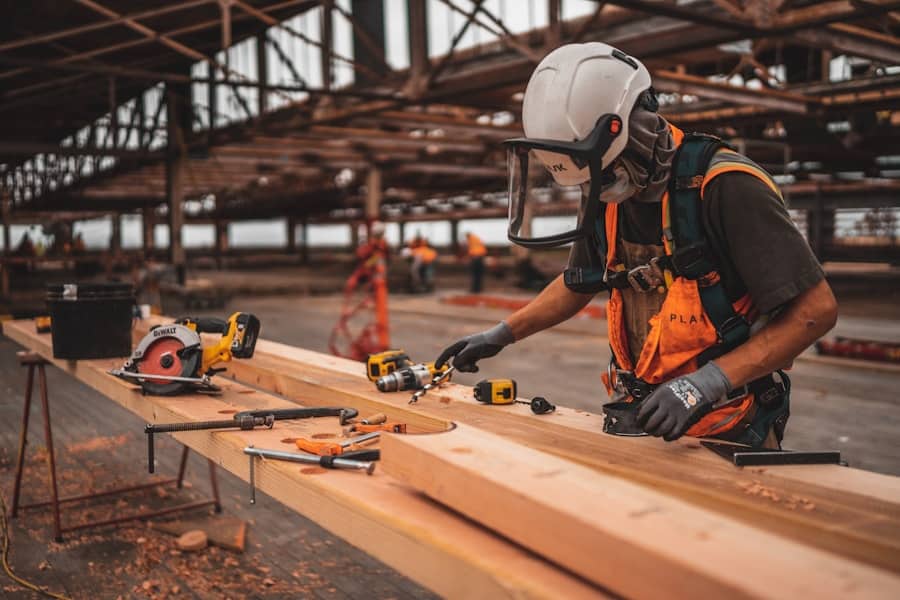
Let the work carry the design. The best construction websites are visually quiet, with large, well-shot photography of finished projects, generous white space and restrained typography, so that the projects are the hero and not the template. Match the colours to your signage and vehicles so the brand is consistent from the site fence to the screen.
Photography is worth budgeting for properly. A half-day with an architectural photographer on two or three of your best completed projects will produce images you use for years, in the gallery, in tenders and on social media. Between professional shoots, get the site supervisor into the habit of taking progress photos on a phone; before, during and after sequences are compelling and cost nothing. Never use stock photos of construction sites. Your prospects can tell and it undermines the one thing the site exists to prove.
Drone footage and 3D walkthroughs earn their place for custom home builders and commercial firms where the scale of the work is part of the pitch. For a renovation business they are usually unnecessary; a clear before-and-after gallery does the job.
Getting found: service pages, suburbs and Google Business Profile
Construction searches in Australia are local and specific: “home builders Mornington Peninsula”, “second storey extension Northcote”, “office fit-out Melbourne CBD”. To appear for them, the site needs a page that matches each one. That means a page per service and, for the regions you genuinely work in, a page per region with real content: projects you have completed there, planning considerations specific to the council and the type of housing stock you work with. Five genuine area pages beat thirty copy-pasted ones, which Google treats as spam.
Your Google Business Profile is the other half of local visibility. Keep it complete, list every service, upload project photos regularly and ask every client for a review at handover, when they are happiest. Our local SEO guide covers the full approach and our on-page SEO guide explains how to structure each page so it ranks.
Over time, a small number of well-written articles answering the questions prospects ask (how long a renovation takes, what a building permit involves in your council, what a fixed-price contract covers) will bring in early-stage buyers before they have shortlisted anyone. That is a slower channel than service pages, but the leads are less price-sensitive because they found you first.
What a construction website costs in Australia in 2026
For most builders and renovators, the right build is a multi-page site with a project gallery, a page per service, a couple of area pages, a process page, reviews and a qualifying enquiry form. We build these from $2,490 plus GST including copywriting and Google Business Profile setup, with our Business Pro package from $3,490 plus GST adding features like project filtering, multi-location support and integration with your CRM or job management software. Across the market, a comparable site from a Melbourne agency runs $2,500 to $8,500 depending on how custom the design is.
Custom home builders and commercial construction firms with large portfolios, a careers section, tender documents and multiple audiences usually need a custom build. Ours start at $7,500 plus GST; larger agencies charge $8,500 to $18,000 and beyond. Our website cost guide has the full breakdown.
Budget separately for photography ($800 to $2,500 for a professional half-day shoot), a .com.au domain ($20 to $60 a year), Australian hosting ($33 to $178 a month) and maintenance from $32.95 a month. And check the contract: you should own the domain, the site and the content outright. Monthly “rent-a-site” plans where you never own anything are common in the building industry and are a bad deal over three years.
Integrating with how you already run jobs
Enquiries from the site should land where you already work, not in an inbox nobody checks. That can be as simple as a form that emails the office and texts the estimator, or a direct connection into Buildertrend, Buildxact, Tradify, simPRO or your CRM so a lead becomes a job record automatically. For companies running a sales pipeline, tracking which enquiries came from which page tells you which services and suburbs are worth more marketing.
Common mistakes on construction websites
A gallery with six photos from 2018. Projects with no suburb, no description and no sense of budget. Registration and insurance details missing, or hidden on an About page. One Services page instead of one page per service. Stock photography. Slow load times because every gallery image is a 6 MB original. A contact form with no qualifying questions, so every enquiry needs a phone call to discover it’s a $5,000 deck. No careers page while spending thousands on recruiters. And a site built in 2016 that still says “over 10 years’ experience” when it’s now nearly twenty. Each of these is cheap to fix and each one costs work.
Keeping it working
Add every completed project to the gallery at handover, when you have the photos and the client’s goodwill for a review. Update registration details and insurance when they renew. Keep pricing guidance current as costs move. Make sure WordPress, the theme and plugins are updated and backed up, either yourself or through a maintenance plan. And check Google Search Console every quarter to see which searches are bringing people in; if a service is getting searches but has no page, write one.
We build fixed-price websites for construction companies across Melbourne and Victoria and you own everything at handover. See our pages for builders in Melbourne and builders and renovators, or look at our showcase.
Frequently asked questions
How much does a website cost for a construction company?
In 2026, a solid builder’s site with a project gallery, service pages and a qualifying enquiry form costs $2,500 to $3,500 plus GST from a specialist and $3,500 to $8,500 from larger Melbourne agencies. Custom builds for firms with large portfolios and multiple audiences start around $7,500. Add photography, hosting and maintenance.
What should a builder’s website include?
A project gallery organised by type with real photos, suburbs and budgets; a page per service; visible registration, insurance and association membership; a plain explanation of your process; named reviews; indicative pricing; a qualifying enquiry form; and, if you hire, a careers page.
Should I show prices on a construction website?
Not a price list, but indicative guidance such as starting prices or per-square-metre ranges. Prospects will ask regardless and honest guidance filters out enquiries you would never win while reassuring the ones you would.
Do I need a separate page for each suburb?
Only for the regions you genuinely work in and only if each page has real content: local projects, council considerations and housing types. Dozens of near-identical suburb pages are treated as spam by Google and can harm the whole site.
How long does it take to build a construction company website?
Two to three weeks for a standard multi-page site once photos and project details are supplied; six to ten weeks for a custom build. Photography and project write-ups are almost always the critical path, so gather them before the build starts.
Can the website connect to my job management software?
Yes. Enquiry forms can feed Buildertrend, Buildxact, Tradify, simPRO and most CRMs directly, so a lead becomes a record without re-typing.
What licence details should be on a Victorian builder’s website?
Your VBA registration number and category, confirmation that Domestic Building Insurance is provided on domestic work over $16,000, your public liability insurance and any HIA or Master Builders Victoria membership. It takes one line in the footer and it is one of the first things a careful client checks.